.webp)







.webp)


Why Restaurant Success Still Requires Experience, Accountability, and Execution
Artificial intelligence has become one of the most talked-about innovations in the restaurant industry, and for good reason. In just a few seconds, it can draft job descriptions, create training outlines, build marketing calendars, suggest menu items, write policies, generate recipes, and even produce financial forecasts.
It's impressive technology.
But here's the question every restaurant operator should ask:
Will any of it actually work in my restaurant?
That's where the conversation changes.
The restaurant business has never been about having the best ideas. It has always been about executing those ideas consistently through hundreds of small decisions made by real people in real restaurants.
Technology can accelerate thinking. It cannot replace experience.
AI Is an Incredible Tool—But It's Still Just a Tool
Think of AI as access to the world's largest brainstorming partner. It can organize information faster than any person, summarize data, identify trends, and help operators complete administrative tasks that once consumed hours.
For restaurant operators juggling labor shortages, rising food costs, staffing challenges, and increasing guest expectations, that's valuable.
Use it.
Have it draft an operations manual.
Ask it to write a marketing campaign.
Generate interview questions.
Create opening checklists.
Build a training outline.
Develop social media content.
Analyze financial ratios.
Those are all excellent uses of AI.
When you move from creating information to making operational decisions, something changes.
Information alone doesn't build successful restaurants.
Execution does.
The Difference Between Knowing and Doing
Imagine asking AI to create a staffing model for your restaurant.
Within seconds, you'll receive recommendations based on projected sales, labor percentages, peak periods, and industry benchmarks.
A staffing plan can look perfect on paper, but restaurants rarely follow the script.
It's Friday night. One of your line cooks calls off. Your newest server is still learning the POS system. The weather is unexpectedly beautiful, so the patio fills up faster than anticipated. Then a bus pulls in with 40 guests you weren't expecting. Meanwhile, you've been limping along with equipment that's overdue for maintenance, and halfway through the dinner rush, the dishwasher goes down.
None of those challenges show up in a staffing model or an AI prompt, yet they're the kinds of situations restaurant operators face every day.
That's why success isn't determined by the quality of the plan; it's determined by how well your team adapts, executes, and solves problems when things don't go according to plan.
Great Operators See What Reports Never Will
Many of the biggest opportunities to improve a restaurant’s performance aren’t uncovered on spreadsheets or dashboards—they reveal themselves during service.
Instead of depending solely on reports, spend a few hours watching the operation during a busy service. That's often where the real opportunities reveal themselves.
You might notice servers taking the long way around because the kitchen layout isn't working. The expo line slows down during every dinner rush, causing ticket times to creep up. Guests wait at the front door because the host is juggling phone calls, takeout orders, and seating. Meanwhile, managers are so busy putting out fires that they never have the chance to coach employees or engage with guests.
Data is an important part of the story, but it's only one part. The rest comes from being on-site—walking the kitchen, observing service, talking with managers and employees, and understanding how the operation performs in real time. That's where the biggest opportunities for improvement are usually found.
Those are the kinds of issues you only discover by being there, watching the operation unfold in real time.
Reports can tell you what happened. They rarely explain why it happened.
That’s where experience makes the difference. It takes someone who understands restaurant operations to recognize the root cause, ask the right questions, and implement practical solutions that improve performance; not just for one shift, but for the long term.
The Hidden Cost of "Good Enough"
One challenge with AI-generated content is that it's often well-written and well-organized. Policies sound polished. Training materials look complete. Standard operating procedures are formatted professionally, and financial recommendations appear reasonable at first glance.
The problem is that a document, no matter how well-written, doesn't improve a restaurant on its own.
Restaurants don't struggle because they lack manuals or checklists. They struggle when systems aren't consistently followed, managers aren't coaching their teams, or processes don't reflect how the operation actually works.
A prep guide is only valuable if the kitchen is organized to support it. A staffing model only works if it fits your team, your guests, and the way your restaurant operates. An operations manual only has an impact when it's used to train, coach, and hold people accountable.
The most successful restaurants aren't the ones with the thickest manuals—they're the ones that have built systems their teams understand, embrace, and execute every day.
AI Doesn't Know Your Restaurant
Every restaurant is different. Even two concepts serving similar menus can operate very differently based on their people, their guests, and the market they serve.
The systems that work for a neighborhood café may fall flat in a luxury steakhouse. A university dining program faces a completely different set of operational challenges than a hotel restaurant. Likewise, a quick-service concept has different staffing needs, service expectations, and production demands from a chef-driven fine-dining restaurant.
That's where experience comes in.
AI can draw from industry best practices, but it doesn't know your operation. It hasn't watched your lunch rush, met your management team, or seen how your guests move through the dining room. It can't recognize the small operational nuances that often make the difference between a recommendation that looks good on paper and one that delivers results in practice.
Those insights come from firsthand observation, operational experience, and an understanding of how restaurants actually function day to day.
Where Experience Changes Everything
At Synergy, we often review operational plans, training materials, and procedures that clients have already developed. More recently, many of those documents have been created with the help of AI. In many cases, they're a solid starting point, but they're rarely ready to implement without refinement.
The reason is simple: every recommendation has to work in the real world.
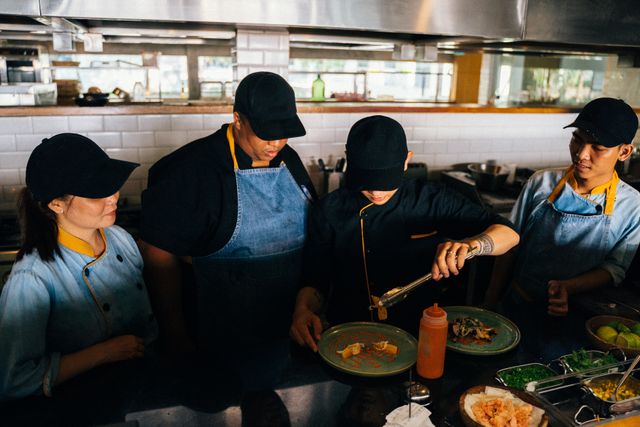
Before we suggest changes, we spend time in the operation. We walk the kitchen during service, observe how the front and back of the house interact, talk with managers and employees, and look for the bottlenecks, workarounds, and habits that never show up in a report.
That's where the real story is.
A recommendation that looks great on paper may not fit your team's actual workflow. A staffing model may overlook operational realities. A training program may fail to address the challenges your managers face every day.
Our job isn't just to recommend best practices, it's to determine which practices will work in your restaurant, with your team, and for your guests. That's the difference between developing a plan and delivering results.
Turning Information into Implementation
Having a good plan is important, but execution separates average restaurants from exceptional ones.
That's been Synergy's focus for more than 30 years.
Our work doesn't stop at recognizing opportunities for improvement. We partner with operators to put those improvements into practice; whether that's developing systems employees will actually follow, coaching managers to become stronger leaders, improving interaction between departments, refining workflows, supporting new restaurant openings, or helping growing brands build the infrastructure they need to scale successfully.
Success doesn't come from having better documentation, it comes from building better habits. Our focus is on creating systems that fit your restaurant's operations, training your team to use them, and giving your managers the tools to reinforce them every day. That's what creates lasting change.
A Better Way to Use AI
The operators who will get the most value from AI aren't the ones trying to replace people with it—they're the ones using it to make their teams more effective.
AI is an effective tool for gathering information, organizing ideas, drafting a first version, and tackling time-consuming administrative tasks. It can save hours and help you get started faster.
But before you put those ideas into practice, they need to be viewed through the lens of your operation. Every recommendation should be tested against the realities of your restaurant, your team, your guests, and your goals.
After working with hundreds of restaurants, you start to observe patterns. You know which ideas are likely to succeed, which ones need some fine-tuning, and which ones simply don't fit a particular operation. That's not something you learn from a report—it's something you learn by being in restaurants and helping operators solve real problems.
Technology can help you work faster. Experience helps you make better decisions. Together, they become a powerful combination.
The Future Isn't AI vs. Consultants
Some people believe AI will eventually replace restaurant consultants. We see it differently.
Access to information has never been easier. Operators can generate policies, training materials, staffing models, marketing plans, and financial analyses in minutes. That's a tremendous advantage.
The challenge isn't finding information anymore; it's knowing what to do with it.
We've worked with restaurants that had impressive business plans but struggled with execution, and others with simpler plans that consistently outperformed because they had disciplined leadership and well-defined operating systems. In this business, it's not the plan that creates results—it's the team's ability to execute it every day.
Anyone can generate a recommendation. The hard part is knowing whether it will actually work in your restaurant. That kind of judgment comes from years of walking kitchens, opening restaurants, coaching leadership teams, and helping operators solve real-world problems.
In this industry, execution has always been the difference-maker, and that isn't likely to change anytime soon.
What AI Can't Do
AI is a useful tool, but there are parts of this business that simply require people.
Some of the most valuable work we do happens on-site. Walking the restaurant during service, observing the flow of the operation, talking with employees, and coaching managers in real time yield insights that can't be captured in a report. Those observations help us develop solutions that fit how the restaurant actually operates, not how it was designed to operate.
Just as importantly, it can't recognize when cultural issues are beginning to affect morale, service, or retention. It won't be there during a restaurant opening to modify the plan when the unexpected happens, and it won't share in the responsibility when a recommendation doesn't deliver the results you expected.
Those are the moments that define successful restaurant operations. They require experience, judgment, and a willingness to work alongside your team until the job is done. That's the role Synergy has played for restaurant operators for more than 30 years.
The Operators Who Will Win
The restaurants that thrive over the next decade won't necessarily be those with the most technology.
They'll be the ones who combine technology with operational excellence.
They'll embrace innovation while being anchored in hospitality.
They'll use AI to work faster—not to think less.
They'll build stronger leaders.
Create better systems.
Develop more engaged teams.
Deliver exceptional guest experiences.
And they'll recognize that success still depends on disciplined execution.
Why It Matters
Artificial intelligence has earned its place in the restaurant industry. Used wisely, it can save time, improve productivity, and generate valuable ideas.
But restaurants are built by people.
Guests return because of the people.
Teams stay because of people.
Cultures grow because of people.
Great operations happen because experienced leaders make thousands of good decisions every single day.
AI is a useful addition to our toolbox, but it's only one of many tools we use. Our clients count on us for something technology can't provide: experienced eyes in the field, practical solutions customized to their operation, and the accountability to help those solutions succeed.
But we also know where technology stops and leadership begins.
Because at the end of the day…
AI provides information.
Synergy provides implementation.
AI accelerates thinking.
Synergy accelerates results.
That's the difference between having an idea, and building a restaurant that succeeds because of it. If you want help turning ideas into execution, contact Synergy Restaurant Consultants.