.webp)









.webp)


Why 2026 is the “ROI-or-bust” year for restaurant AI
By 2026, AI won’t feel like a novelty. It’ll feel like electricity: expected, embedded, and invisible when it’s done right. The problem is that many operators will still waste money chasing “cool” tools that don’t improve speed, accuracy, labor, or guest satisfaction.
The good news: owners are increasingly open to using AI and are looking for practical benefits (not sci-fi promises). In Toast’s 2025 operator survey, 86% said they’re comfortable using AI, 81% expect to use more of it, and 81% believe it will help them run more efficiently. Toast POS
At the same time, off-premises demand continues to raise the bar for speed and accuracy—nearly 75% of restaurant traffic now occurs off-premises, according to the National Restaurant Association’s 2025 Off-Premises Restaurant Trends data (NRA).
The real 2026 question is simple: where does AI measurably reduce friction?
Where AI actually helps (high-ROI use cases)
Below are the areas we see delivering the most consistent ROI for restaurants because they reduce waste, protect throughput, or free managers from repetitive work.
1) Inventory + purchasing: fewer 86’s, less waste
AI shines when it turns sales patterns into smarter pars, prep, and ordering. Deloitte’s research notes that inventory management is already an everyday AI use case among surveyed restaurant leaders. Deloitte
What to measure: food cost variance, waste, stockouts, vendor order accuracy, and weekly ordering time.
2) Labor forecasting + scheduling: stop staffing by gut feel
The biggest wins come when AI forecasts demand by daypart and helps managers build schedules that align with sales reality. Even small gains matter because labor is usually your biggest controllable cost.
What to measure: labor % vs. sales, overtime hours, missed breaks, manager time spent scheduling, and speed of service during peaks.
3) Phone handling and reservations: eliminate the “black hole”
If your team misses calls during rushes, that’s lost revenue—period. AI voice tools can handle common requests (hours, location, wait times, basic reservations) and route the rest to humans. This aligns with what many operators heard at NRA 2025: AI is increasingly viewed as a way to remove tedious tasks so teams can focus on hospitality. OpenTable

What to measure: missed-call rate, reservation conversion, call handle time, and guest complaints tied to the phone experience.
4) Menu engineering: spotlight what sells and cut what slows you down
AI-supported reporting can help identify:
• Items that print money (??) but get buried on the menu
• Items that crush the line during peaks
• Modifiers that drive ticket time and remake risk
What to measure: contribution margin by item, ticket time by station, comp/remake rate, and menu mix shifts after changes.
5) Marketing content and campaign testing: faster, not “fully automated”
AI excels at generating first drafts of promos, emails, and social variations—then humans choose what fits the brand. Used well, this cuts marketing bottlenecks without making your brand sound generic.
What to measure: campaign speed to launch, offer redemption rate, email/SMS engagement, and ROAS where applicable.
Where AI wastes money (common traps we see)
These are the “sounds impressive, underdelivers fast” categories—especially when tools aren’t integrated with POS, inventory, KDS, or scheduling.
1) AI chatbots that aren’t connected to real systems
If a bot can’t show hours, reservations, menu availability, or order status, it mostly causes frustration. Guests don’t want a conversation—they want an answer.
2) Voice AI without menu simplification and training
Voice ordering can work, but it fails when menus are overly complex, modifiers are endless, and store teams aren’t trained in exception handling. If you’re not operationally ready, the tech becomes the scapegoat.
3) Too many point solutions
Buying five separate AI tools often means five logins, five dashboards, and zero accountability. AI needs a single “source of truth” (POS + inventory + labor), or it becomes noise.
4) “Replace the manager” fantasies
AI can summarize trends, flag issues, and suggest actions. It cannot set culture, coach performance, or create hospitality. When owners expect replacement rather than augmentation, implementation collapses.
A practical 90-day AI plan for restaurant owners
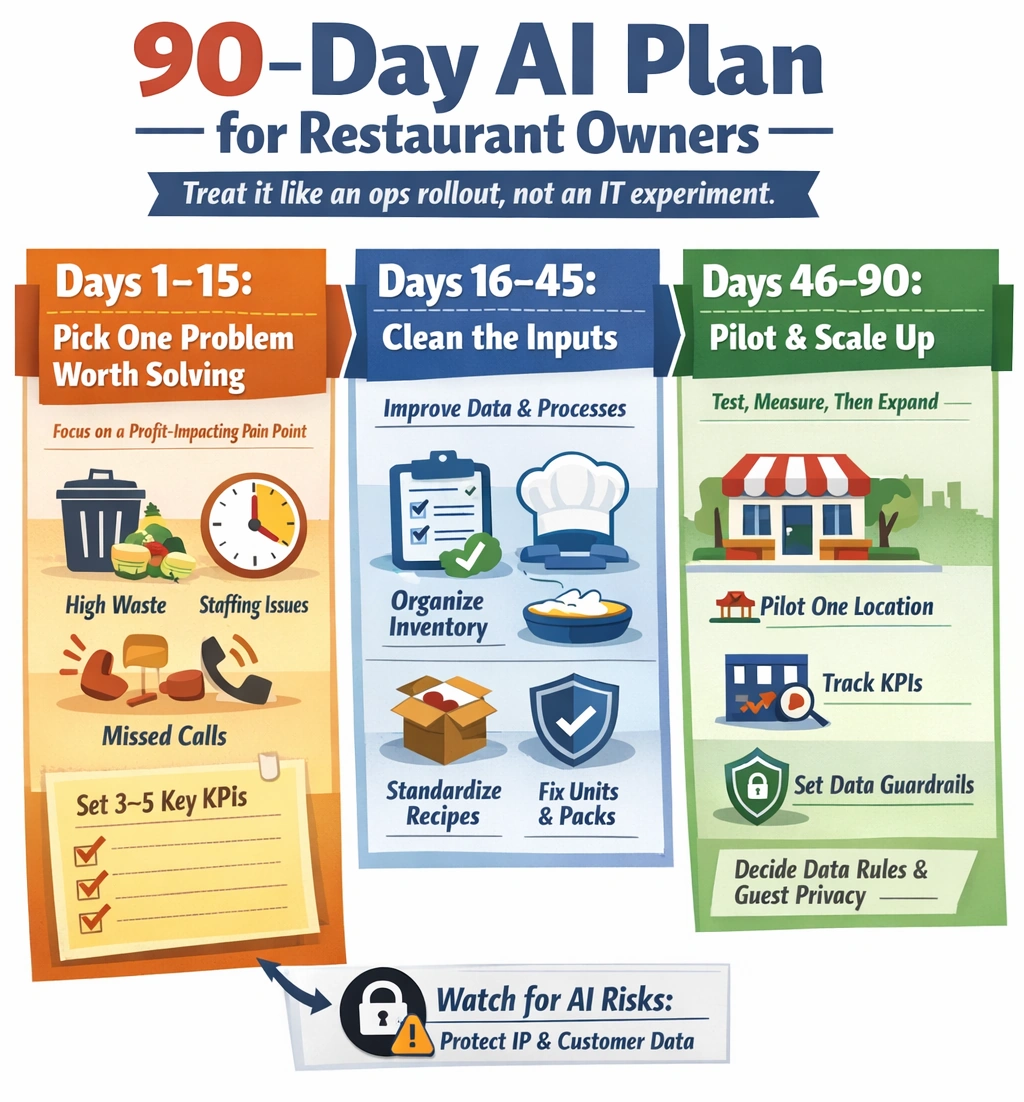
If you want AI to pay for itself, run it like an ops rollout, not an IT experiment.
Days 1–15: Pick one problem worth solving
Choose a pain point tied to dollars:
- High waste / frequent stockouts
- Overtime creep and inconsistent staffing
- Missed calls / lost reservations
Define 3–5 KPIs up front.
Days 16–45: Clean the inputs
AI is only as good as the data and workflows feeding it:
- Tighten item naming and modifiers
- Standardize recipes and prep yields
- Fix inventory units and vendor pack sizes
- Confirm labor roles and job codes are accurate
Days 46–90: Pilot, measure, then scale
Pilot one store (or one daypart) first. Train managers on how the tool aligns with the shift rhythm. Scale only after you see KPI movement.
Also, build basic guardrails. Deloitte notes that restaurant leaders cite concerns such as intellectual property issues and misuse of customer data as AI risks. Deloitte
That means you should decide now what data is allowed, who approves outputs, and how guest data is handled.
The 2026 bottom line
AI is not a strategy. It’s a lever. In 2026, the winners won’t be the brands with the most AI—they’ll be the ones using AI to protect throughput, reduce waste, and give managers more time on the floor with guests and teams.
If you want help choosing the right use cases (and avoiding costly distractions), Synergy Restaurant Consultants can identify your highest-ROI opportunities and build an implementation plan that fits your concept, systems, and staffing reality.